
Best Vegan Collagen for Radiant Skin: 2026 Guide
Table of Contents
- What Is Vegan Collagen and How Does It Support Radiant Skin?
- Plant-Based Collagen vs Animal Collagen: What's the Difference?
- Vegan Collagen Booster Benefits for Skin Hydration and Elasticity
- How Long Does Vegan Collagen Take to Work?
- What to Look for in the Best Vegan Collagen for Radiant Skin
- Safety, Contraindications, and Medication Interactions
- Frequently Asked Questions
Last Updated: September 28, 2026
What Is Vegan Collagen and How Does It Support Radiant Skin?
Vegan collagen is a plant-based formulation that supports your body's own collagen production rather than supplying collagen directly. This guide explains how these formulas work, what to look for, and whether the best vegan collagen for radiant skin is worth buying.
Key Ingredients That Support Collagen Production
Certain ingredients do the heavy lifting in plant-based collagen formulas:
- Vitamin C plays a direct role in collagen synthesis and also supports normal skin barrier function
- Glycine and proline are the amino acids most abundant in collagen itself
- Bamboo silica is a plant source of silicon, a trace mineral found in connective tissue
- Hyaluronic acid supports skin hydration and suppleness
- Antioxidants from plant extracts help protect skin cells from oxidative stress
Plant-Based Collagen vs Animal Collagen: What's the Difference?
Animal-derived collagen supplies pre-formed collagen peptides. Plant-based formulas take the indirect route, providing the raw materials and cofactors your body uses to build collagen itself.
| Feature | Plant-Based Collagen | Animal Collagen |
|---|---|---|
| What it contains | Amino acids, vitamin C, botanicals | Hydrolysed collagen peptides |
| How it works | Supports your own production | Supplies collagen directly |
| Suitability | Vegan, vegetarian-friendly | Not suitable for vegans |
| Sourcing | Plant extracts, ethical sourcing | Bovine, porcine or marine |
| Digestive tolerance | Generally gentler | Can cause discomfort for some |
Vegan Collagen Booster Benefits for Skin Hydration and Elasticity
A well-formulated vegan collagen booster benefits skin gradually rather than overnight. Most people chase three outcomes: better hydration, improved firmness, and a more even complexion.
How Vegan Collagen Boosters Differ from Animal-Derived Collagen
The mechanism is the real difference: animal collagen delivers peptides your body breaks down and reassembles, while vegan collagen boosters supply the ingredients for synthesis directly.
How Long Does Vegan Collagen Take to Work?
How long does vegan collagen take to work? Expect eight to twelve weeks of consistent daily use before judging results. Collagen turnover in skin is slow, and no supplement speeds up that biology.
What to Look for in the Best Vegan Collagen for Radiant Skin
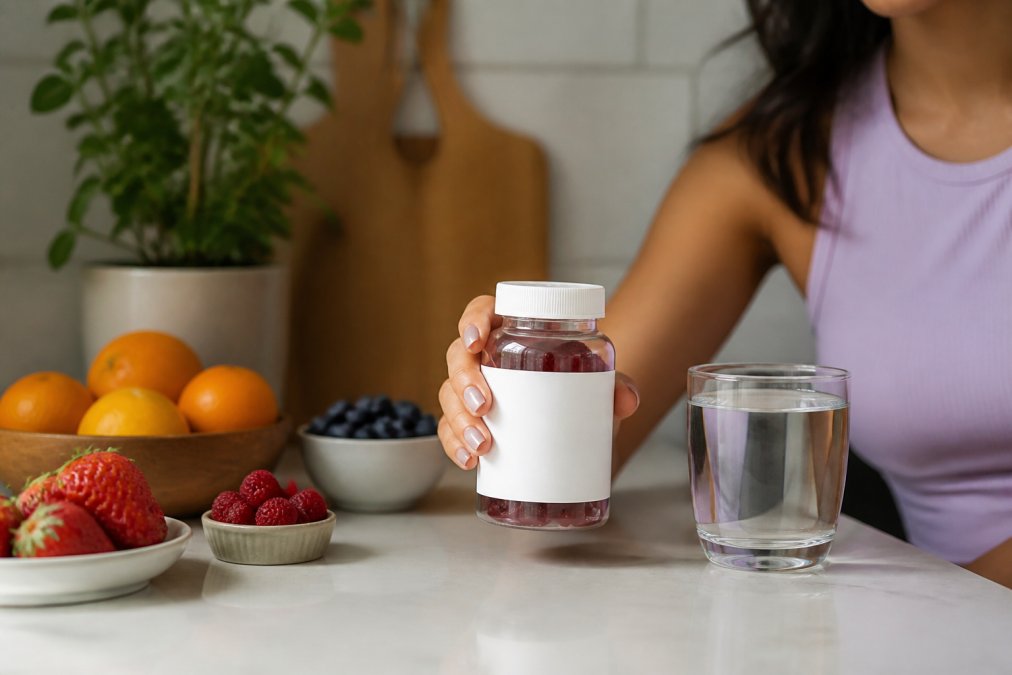
Judge a formula on five things: what it contains, how well you absorb it, whether doses are meaningful, whether it has been independently tested, and cost per day. Most shoppers only check the last one, which is why so many end up with an expensive tub of decoration.
Start with the category, not the brand
Before comparing products, be clear which of three things you are buying:
- True collagen peptides, hydrolysed animal collagen. Not vegan, full stop. If a plant-based product claims to contain "collagen peptides", the claim is either misleading or the product is not vegan.
- Collagen-support nutrients, vitamin C, glycine, proline, copper, silica, hyaluronic acid. These are the raw materials and cofactors your body uses to build its own collagen. This is what a legitimate vegan collagen supplement contains.
- Collagen boosters, botanical extracts marketed to "stimulate" collagen. The evidence here is much thinner than for the nutrients above, and the marketing is usually louder.
Bioavailability: the part most labels avoid
Bioavailability means how much of a nutrient you actually absorb and use rather than excrete. It is the biggest difference between a formula that works and one that does not, and it is almost never printed on the tub.
A few practical points:
- Vitamin C is well absorbed at typical supplemental doses, but absorption falls off sharply above roughly 1,000 mg in a single sitting. A formula that splits vitamin C across two servings is usually better than one that dumps a huge dose into a single capsule.
- Amino acids compete with each other for the same transporters in the gut. A blend with a sensible ratio of glycine to proline absorbs more predictably than one that lists ten amino acids at token amounts.
- Silica from bamboo is poorly absorbed in its raw form. Look for it alongside a delivery format that has been processed for absorption, or treat it as a supporting ingredient rather than a headline one.
- Hyaluronic acid taken orally is broken down in the gut; the evidence for it reaching the skin intact is limited. It is a reasonable addition, not a reason to pay a premium.
Dose, not decoration
A label can list every impressive-sounding ingredient and still be underdosed. Two checks catch most of this:
- Look for individual amounts. If the label says "Proprietary Collagen Support Blend, 800 mg" with no breakdown, you cannot tell whether the vitamin C is 500 mg or 5 mg. Treat that as a no.
- Compare against reference intakes. The NHS guidance on vitamins and minerals sets out reference intakes for vitamin C and other nutrients. A formula that supplies a meaningful share of your daily vitamin C is doing real work; one that supplies 4% is not.
Third-party testing and UK labelling
In the UK, supplements are regulated as food, not medicine, so they cannot claim to treat, cure or prevent anything, and quality control sits largely with the manufacturer. Independent lab testing, sometimes shown as a certificate of analysis, is the clearest signal that what is on the label is in the bottle.
Cost per serving: the only fair comparison
Cost per serving = pack price ÷ number of servings in the pack
- Product A: £24 for 30 servings = £0.80 per serving, with 80 mg vitamin C and 500 mg amino acid blend per serving.
- Product B: £36 for 60 servings = £0.60 per serving, with 160 mg vitamin C and 1,000 mg amino acid blend per serving.
Before you buy, write down three numbers: cost per serving, vitamin C per serving, and total amino acid blend per serving. Any product that cannot give you all three is not a product you can compare fairly.
A quick pre-purchase checklist
- Vegan claim is specific, not just "plant-based"
- Vitamin C listed with an individual amount
- Glycine and proline present, or a clearly named amino acid blend
- No hidden proprietary blend without a breakdown
- Independent lab testing referenced
- Cost per serving calculated and compared
- Made by a brand that will answer questions about sourcing
Safety, Contraindications, and Medication Interactions
Most plant-based collagen supplements are well tolerated, but that is not the same as suitable for everyone. This is the section most round-ups skip, and the one worth reading before you spend anything.
Who should be cautious
People on blood-thinning medication. Some botanical extracts used in collagen formulas, including certain forms of turmeric, ginger and ginkgo, can affect clotting. If you take warfarin, a direct oral anticoagulant, or even low-dose aspirin daily, this is a conversation to have with your prescriber, not a decision to make from a label.
Medication timing, not just medication choice
Even without a direct interaction, timing can matter. Vitamin C increases iron absorption, which helps some people and not others. If you take levothyroxine, keep at least four hours between it and any supplement containing iron, calcium or magnesium, as these reduce absorption.
What the label cannot legally say
In the UK, supplements are regulated as food, not medicine, and cannot claim to treat, cure or prevent any disease. Watch for:
- Claims to "reverse" or "cure" a skin condition
- Testimonials framed as medical outcomes
- Before-and-after images presented as clinical evidence
- "Doctor-formulated" with no named doctor or published research
If you experience stomach upset, headaches, changes to your skin, or any unexpected symptom after starting a supplement, stop taking it and speak to a pharmacist. Bring the label. Do not "push through" to see if it settles.
Reporting a problem
If you suspect a supplement has caused a side effect, you can report it through the Yellow Card scheme, which is the UK's system for monitoring the safety of medicines and healthcare products. For general guidance on supplement safety and what nutrients do, the NHS advice on supplements is a sensible starting point.
The bottom line on safety
For most healthy adults not on medication, a well-formulated vegan collagen supplement at the label dose is low risk. Those who need to check first are people on blood thinners, thyroid or diabetes medication, anyone with a history of kidney stones, and anyone pregnant, breastfeeding, or about to have surgery. A short list, but the one that matters.
Frequently Asked Questions
What is the best vegan collagen for skin?
The best vegan collagen for skin is one that provides key cofactors like vitamin C, amino acids such as proline and glycine, and plant-based antioxidants. Look for a formula that supports your body's natural collagen production rather than supplying collagen directly. Lumorawellness Radiance Gummies are a plant-based option made with lab-tested ingredients. Always check the label for vegan certification and avoid fillers that may irritate sensitive stomachs.
Is there any vegan collagen that is actually effective?
Vegan collagen supplements do not contain actual collagen; instead, they provide nutrients that support your body's own collagen synthesis. Ingredients like vitamin C, bamboo silica, and amino acids can help maintain skin elasticity and hydration. Effectiveness depends on consistent use over 8 to 12 weeks. Some people notice brighter, more supple skin sooner, but results vary. Choose a product with transparent labelling and a formulation designed for bioavailability.
Can I take a collagen supplement with citalopram?
There is no known interaction between vegan collagen supplements and citalopram, but individual responses vary. Some ingredients, such as certain herbs or high-dose vitamins, could theoretically interact with medications. Always speak to your GP or pharmacist before starting any new supplement, especially if you take prescription medication. They can advise based on your full medical history and current prescriptions.
How long does it take to see results from vegan collagen supplements?
Most people may notice initial improvements in skin hydration and brightness within 4 to 6 weeks, but firmer, more elastic skin typically takes 8 to 12 weeks of daily use. Factors like age, diet, and overall health influence the timeline. Consistency is key: take your supplement every day as part of a daily wellness routine. If you see no change after three months, consider reviewing your diet or consulting a dermatologist.
Radiant skin is not a single purchase. It is a routine you keep, and most people give up long before the eight-week mark where results start to show. Lumorawellness makes that routine easier with Radiance Gummies: 100% plant-based, lab tested, made in the UK, and formulated to help your body produce its own collagen for stronger hair, radiant skin, and healthier nails. Shop Now and give your skin the twelve weeks it deserves.